March 2017 banner

March 2017 banner
Showing posts with label Simonini Victor 2. Show all posts

Saturday, 2 October 2021

2 stroke engine leaking oil..?

I have finally had my first true Simoninin Victor 2 issue

Since some time I have had an issue with my Victor 2 leaking oil… Problem is that it is a 2 stroke engine running on premix so there is no oil to leak… and still I had drops of oil forming on the lower parts on the engine. 

Where did the oil come from? It was not any large quantities and I could not see a source of the oil leak when the engine was running. But still I had oil smeared all over at landing and drops forming on the lowest part of the engine.

After reading a post on a 2 stroke Facebook page about someone who had burnt the cylinder gaskets due to insufficient cooling and had an "oil leak" as a result I thought I should at least verify - and there it was, not burnt but "aspired" gaskets!


Note how the gasket is deformed and on the right hand side there is about 1 mm gasket width while on the left side the gasket is no longer covering the gap. The gaskets have been aspired into the cylinder. Didn't know that was a thing...

On the other cylinder the left hand side is has a gap where a part of the gasket has completely disappeared while the other side is intact.

I have since heard from another Victor 2 owner who had experienced the same thing. 
And Simonini must have known about the issue as they replied "you must use between cylinders and gaskets Arexon packing seal putty or Loctite 3020".

I have installed new gaskets, with the appropriate Loctite product, and the issue appears resolved. Due to the heat of the cylinders the oil did not stay near the source of the leak so while it was easy to fix it was hard to find...


Wednesday, 24 July 2019

New engine bushings - off the shelf !


It was time to replace my engine mount bushings. This has always been a pain as they are normally cut out of "a sheet of rubber" without indication of specific characteristics... Last time someone in the Avid Flyer club organized a grouped order at a rubber supplier. This time I was looking for a different solution.
After hours on the web I found a model that appeared to have the correct form factor and size. 
Talking to the manufacturer (Hutchinson Paulstra click to visit) they recommended the softest version. Due to the central part of the bushing being enclosed in the engine mount they don't give the shores rating as this could be misleading. 
The reference of the ordered model is 530903-21.


While the final shape of the bushing looks like the original it is more sophisticated and give a very serious impression. 
The central metal tube is wider than the original but the original tube fit perfectly inside the wider tube. No need to adjust the length. The fit between engine mount and bushing is perfect and the replacement of the bushings can be done in 30 in minutes.
After several hours in the air with the new bushings I'm very happy with the result. Vibrations are reduced and I have noticed no adverse effects. I can feel it and you will see it in my next film...

Monday, 25 June 2018

The Wow-Prop...

When changing to the Simonini engine I increased the pitch of my 66 inch Warp Drive prop but had the impression I didn't get the performance I expected. After long back and forth with a Spanish propeller maker I ordered a 2 blade custom built 72 inch wood prop. It looked soo good... and under winter conditions it worked well - not so in the less dense air of hot summer.
I have just received a swept blade (Scimitar) 72 inch prop from NR-prop in Ukraine (also known as "Kool prop" or "Luga prop" but I call it to "wow-prop"...) 

 My first impressions are very positive:
  • Very smooth
  • Low noise
  • 20+ km/h maximum speed
  • 700-1000 lower RPM at normal cruise speed
  • Unbeatable price
  • Good experience buying directly from Ukraine
Click to visit the NR-Prop
(My only relation to NR prop is as a happy customer)

Tuesday, 17 October 2017

The first real problem

Yeah, I have had my first problem with my Simonini Victor 2 (spoiler alert, problem unrelated to Simonini!).
Since some time the engine got more difficult to start and didn’t spin as usual. Once started and warm I check the magnetos. As I use a “tiny tach” I can only see the actual RPM on one of the circuits but by ear the slight difference appeared normal.
I had a doubt in the air and, with sufficient altitude and airfield in view, did the test again. Left magneto “off” – no difference, actually none what so ever… Switched to the right magneto and had the impression I was running on one cylinder. Oops…!
After landing  I noticed that both magnetos appeared to work on low RPM but that the left magneto failed at higher RPM. This rapidly got worse and I noticed issues also on lower RPM where the engine would rapidly stop.
Revamping all connections from right to left, no difference. Simonini Victor 2 is using the same Ducati double ignition coils as Rotax 582 so it was easy to get a new one. Once installed all got back to normal.
So no blame on Simonini, with the same coil I would have had this issue on any engine...
"The most widely reported problem with the Rotax ignition system is in the failure of the ignition coils, and pickups on the Dual CDI engines." according to ultralightnews.com

One question remain... Why does a brand new ignition coil go bad after 140 hours?

Tuesday, 10 December 2013

Ricardo is testing BPR9ES

Experiencing the same problem as me with excess oil in the spark plugs (engine mounted heads down) Ricardo is on Peter's advice testing BPR9ES spark plugs. 
Illustration "stolen" from Ricardo's blog... clickable link
Peter has been reporting significant improvement with those spark plugs where the electrode is slightly more prominent than on the regular B9ES.
To be followed...

Monday, 1 July 2013

Back to square one…

Slightly exaggerated illustration...
After my last flight (3 weeks ago) I had not only closed the fuel tap on the firewall but also let the engine run dry.
Yesterday I went out to the field to prepare the plane for a longer flight next weekend, I removed the spark plugs to make sure they were clean, re-gap etc.
2 spark plugs (one per cylinder) were overflowing with oil, the 2 others just full of oil… I would not have been able to start.
While the fuel tap improves the situation it does not eliminate the problem, nor does fuel tap and running the engine dry...
So what about the quantity of oil? I have not measured the quantity but estimate it to be a little less than a teaspoon – and I don’t know if there is more oil in the engine… A teaspoon is 5 ml and with 2% oil this would represent ¼ liter mixture, or the consumption for less than 1.5 minutes.
Knowing that similar problems on other engines have been resolved by using longer spark plugs (to prevent the excess oil from running in to the spark plug) I have asked Simonini for advice. 

Thursday, 9 May 2013

And yes, it works....

Right, 3 weeks since last flight... it should normally be impossible to start without removing and cleaning excess oil from the 4 spark plugs - if normally is without a closed fuel tap...
But as I had not only installed a fuel tap right on the fire wall prior to my last flight but also closed it I had no problems starting the engine.
Or put differently even when closed the Bing carburettors leak fule and slowly flood the engine and the oil remains in the cylinder head if there is a gravity feed from the fuel tanks.

Wednesday, 10 April 2013

Rain and firewall fuel taps


As you have seen in the comments there is a discussion about excess oil in heads down cylinders and fuel taps. The theory is that with wing tanks (high wings) fuel continues to slowly flow through the carburetors due to the gravity feed and that the oil is deposited in the cylinder head while the fuel evaporate or disappears elsewhere – if there is no fuel tap prevent this.
As I’m normally not a friend of fuel taps (risk of forgetting them, point of obstruction, leaks…) I had reduced them to a minimum.
I have reconsidered and have now installed a fuel tap on the firewall, operated directly on the dashboard. I did this some time ago but as the weather has been dreadful most of the time and particularly so when I had the time to fly I have not yet been able to test this.
As soon as I can confirm that this is actually solving the problem you will be the first to know!

Monday, 28 January 2013

Bingo Simonini Victor 2 experiences from Spain

Ricardo Louis Garcia, who fly a Bingo with a Simonini Victor 2,  has just created a blog that I suggest you bookmark if you are interested in Simonini Victor 2 experiences.
Ricardo's blog is in Spanish but just like on this blog you can get a translation by selecting your preferred language.
Bingo Simonini Victor 2 experiences from Spain

Thursday, 1 March 2012

Started on first try

From too cold to full spring in a few weeks. Never had the time to get the skis on the plane…
Not a cloud in the sky today, light winds and 19 degrees (C), just irresistible. This was my first flight since November and was curious to see if Victor would wake up easily from the long hibernation…
Filled the tank with new fresh fuel, 2% mixture. I drained the excessive oil from the cylinders (where does all this oil come from?), swung the prop for 30 seconds to get fuel in the carburetors. Contact, ignition, wroooom. Started right away, like if I had been flying the same morning. That was nice.
Visited a nearby field and got 1h15 in the air. No performance measures, just getting back in the air, enjoying some pure pleasure…

Wednesday, 2 November 2011

Simple and efficient

One reaction I got on my video was a suggestion on a very simple and efficient system to retain/secure the spark plug caps.
4 washers grinded down to oval shape, 2 holes in each washer and a piece of 4mm bungee cord…
Adopted and implemented, thank you MichaeL!

Monday, 17 October 2011

An autumn flight to a nearby field

Some views of the engine when I drain the excess oil from the cylinders, some engine sound when starting up. The rest is just for your eyes...

Wednesday, 14 September 2011

2% oil mixture


Enzo Simonini has confirmed by email that 2% oil mixture is sufficient under the condition of using a high quality 2 stroke oil. As the user  manual says 3% this will be a 33% reduction (and economy)...

Monday, 18 July 2011

More flights...

I have done some more flying, adding another 2.5 hours. For the last hour I added another 3° degree of pitch (i.e. total 7° more than with the 532). It made almost more difference than the first 4° degrees. I can now outrun my airspeed indicator at level flight (limited to 150 km/h - 93mph)!
With cool air just after the rain I still have a 6050 RPM maximum. Comfortable cruising speed 110-120 km/h around 4800RPM.
Takeoff is still very good so I will try another 1-2° pitch before doing serious fuel consumption estimations.

Wednesday, 29 June 2011

Second flight

I did fly last Friday as planned. Rather windy and with strong thermals, i.e. not the ideal conditions to make precise performance or consumption measurements.
For the next flight I will do some prop adjustments by increasing the pitch even more. I know little about props but I have the feeling I don’t get the most out of the current setup. 

The first consumption number after 1 hour flight in rough conditions is ~13 l/h (3.4 gallons US/hour).  This is 25% less than my 532 at comparable speed (but with incomparable takeoff and climb performance). However, don’t consider this as final numbers!

Monday, 20 June 2011

First flight experience and sound

Following Peter’s advice I adjusted the propeller pitch before my first test flight. This was the first time I’ve touched the pitch and I had been told that 1° is about 300 RPM for 60hp. I started with 2° and got 6350 RPM static. Another 2° got it down to 6100. That should do for test flights and I will fine tune later if required. But the more pitch the less power at takeoff and climb. 4° appeared to be a lot... 
There is nothing you can’t do with an iPhone (the app is iHandy Level)

For the first time in 21 months I was about to fly again... lined up at the end of the field, full power, breaks released... oh yes, there was takeoff power left. Must have been my shortest takeoff ever in despite of the light tailwind. Acceleration and climb... a little too concentrated on flying to verify the climb rate (will do that next time) but it was steep...
I did 3 takeoffs (and obviously 3 landings) for a total of 35 minutes in the air so I don’t have more than first impressions to share. I hope to fly again Friday this week.
Both on the ground and in the air the sound is lower than 532/582. That the exhaust pipes end almost behind the pilot, rather than in front of the pilot, obviously helps to lower the sound in the cabin.
Power at takeoff and clime is very satisfying.  Cruising 110 km/h at 5000 RPM (to be confirmed) no vibration and acceptable sound when removing the headset.  No tendency to vibrations at higher RPM and stay at set speed.
Click here if you want to listen to the Italian tigress’ roar. You can either listen directly using the player at the page or download the mp3 file. The recorder is set on the ground about 1 meter from the wingtip and the plane secured.  There is some wind noise, sorry about that... It almost sounds like 2 engines running in parallel. I wonder if this is due to the individual pipes or if there is some carburettor fine-tuning to be done.

Friday, 17 June 2011

Roaring Italian tigress at 6550 RPM static

I was out at the field at lunch today. I installed the new Tiny Tach and had the engine running again. Started very easy again at first try.
Static I get 6550 RPM at full throttle. This leave room to optimize the prop setting but I should be able to fly without modifications.

I had decided not to take off today so when releasing the breaks at full power at the end of the field it required some concentration to actually stay on the ground. The acceleration is impressive.

To raise the tail at standstill and turn on rudder is not a problem. You can dose the power very precisely. While taxing around at various speeds for almost 30 minutes all indicators stayed in the green.

I will check CG and do a serious pre-flight check on all the new bolts but I cannot think of anything else between me and the first flight behind my Simonini Victor 2. 
According to the weather forecast this might be Sunday this week.

Stay tuned...

Monday, 13 June 2011

Finally and Wow!

Everything connected and ready to run!
 
There are some minor details that will be done later but today I took my bird down to the field to test the engine for the first time.
I had charged my battery over night but it didn’t stand a chance. The compression in the Simonini has nothing to do with my old and tired 532. Luckily we always have a fully charged regular car battery at the club and with that the engine fired as soon as the fuel reached the carburettors. A few seconds of choke and she was running smoothly. Maybe a tendency to vibrations at low rev but I run with the cowling open due to the external battery so that will have to be confirmed. However, steady as a rock at higher revolutions. Unfortunately my old Tiny Tach was not compatible with the new ignition (bailed out at 9999 rev/min...) so I could not safely test the full potential. I’m expecting that I have to adjust my prop (or replace it) so I was afraid of exceeding maximum RPM (6200). A new Tiny Tach should be arriving later this week...
First impression was really Wow - this is more power than I expected. I was impressed and so was the crowd that had gathered. There is no question that I have more, much more, power than before.
The sound is exciting, not too loud and not to high pitch. Appears lower from inside the plane than my 532. 

Tuesday, 7 June 2011

Exhaust system in place

I earlier announced the installation of the exhaust system to be the next challenge. The reason was the length of pipes in combination with the landing gear. It turned out to be easier than expected.

The double exhaust elbows allows a very free positioning of the pipes and it was not too difficult to find a position, slightly across rather than straight, and have them fit between the legs of the landing gear. 
The 4 springs on the exhaust support are expected to keep the pipes level and maintain the required distance to the legs (the attachment in the front will be replaced with a second rubber damper) . The harder landing the less distance...
A slightly increased opening in the lower cowling...
Finished... at least almost, some silver paint and that second rubber damper is missing, but still...

So what is left? All connections are completed on the engine side of the firewall. I’m currently updating the dashboard. If all goes as planned I should b able to start the engine this coming weekend!

Monday, 9 May 2011

Slowly getting there…


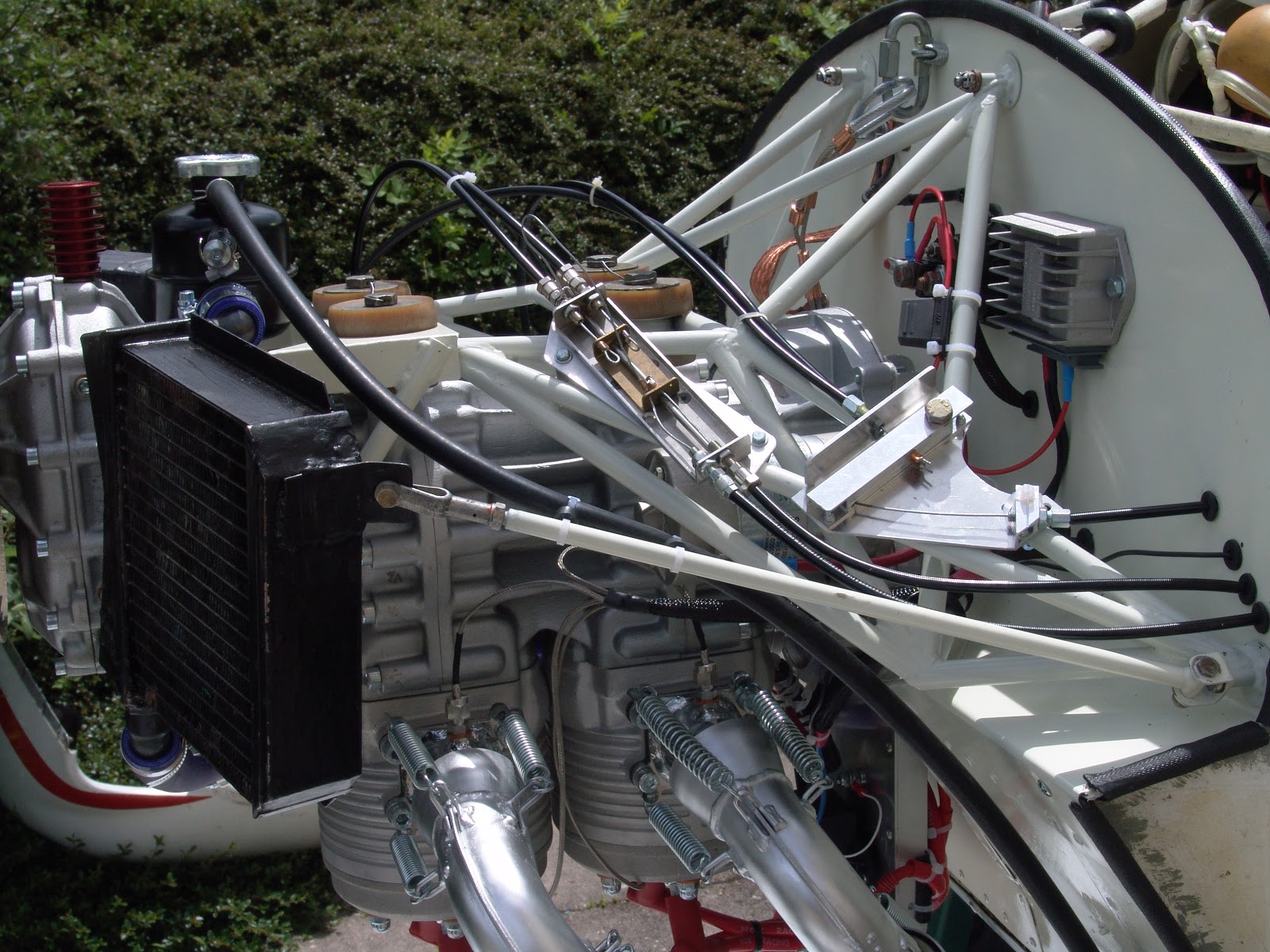
The engine is now permanently in place but nothing connected yet.  ...and I just realize that I forgot to document the simplified back plate and the moved ignition coils (see my earlier post Remodelling the engine mount and My current engine mount will not fit)... too late now...
 I can already reveal that the next challenge will be the exhaust system in relation to the landing gear…